Take our quiz to find the best commercial zero-turn mower or best residential zero-turn mower for you.
Easily compare all riding lawn mower attachments to see how you can get more out of your mower.
Your local dealer can also offer great service and support for your riding lawn mower. Find the dealer nearest you.
Elite performance doesn't need to cost elite money. Get 0.98% APR financing for 48 months on any new Grasshopper zero-turn mower.
How commercial landscape companies benefit from standardized mower fleets
Key takeaways in this article
- Six ways to save: Standardizing a landscape company's mower fleet to a single brand cuts costs across six distinct areas.
- Fewer parts to stock: A single-brand fleet shrinks parts inventory, and Grasshopper Mower offers high parts commonality across its models.
- Easier operator training: Similar controls and feel simplify training and allow a landscape company to shift crews between zero-turn mowers freely.
- Stronger buying power: Consolidating spend to one manufacturer boosts buying power, and Grasshopper Mower offers fleet pricing even on a single added unit.
- Convert in phases: Standardize gradually over a few years, judging brands on cut quality, durability, dealer support, and total cost.
As a landscape company grows to the point of having multiple maintenance crews, it’s important to establish consistency across those crews. This is where systems and standardization come into play. When everyone is trained the same way and performing tasks the same way, it’s easier to maintain quality and maximize productivity.
Standardizing a commercial lawn mowing equipment fleet can play a big part in this. When every crew is operating the same equipment, you create the consistency needed to streamline both operator training and fleet management.
Standardizing equipment like trimmers and blowers is relatively simple because there isn’t much variability in how they are used from one property to the next. Standardizing mowers, on the other hand, can be a little trickier because certain properties may require certain mower sizes and types. But standardizing mowers can still be done when you partner with a manufacturer that can provide the varied solutions your operation needs.
Does standardizing a lawn mower fleet to one brand actually save money?
Standardizing a lawn care fleet to a single brand will help a landscape company save money in six ways:
- Streamlined parts inventory
- Predictable maintenance scheduling
- Faster equipment service
- Simplified operator training
- Stronger buying power
- Stronger resale/trade-in value
1. Streamlined parts inventory
Operating several brands of zero-turn lawn mowers can complicate parts stocking, as each brand may require its own unique parts. When you’re looking to maintain a reliable stock of wear items like tires and casters, belts, blades, spindles, and pulleys, etc., parts inventory can balloon quickly.
By standardizing to a single brand, you can narrow your overall parts inventory but still ensure that the essential items are always in stock. This is possible even when operating more than one mower type (e.g., midmount zero-turns and stand-on mowers). Grasshopper, for instance, is known for having a high degree of parts commonality across models.
2. Predictable maintenance scheduling
Standardizing a mower fleet makes preventive maintenance scheduling easier. This is especially the case when you standardize a single engine and transmission which creates uniform maintenance intervals across the fleet. But even when you have several types of engines and transmissions, standardizing a single mower brand can streamline maintenance. Grasshopper, for instance, has achieved a high degree of parts commonality across mower models. Thus, preventive maintenance tasks like greasing bearings, sharpening blades, and inspecting belts and other wear items are the same from mower to mower.
3. Faster equipment service
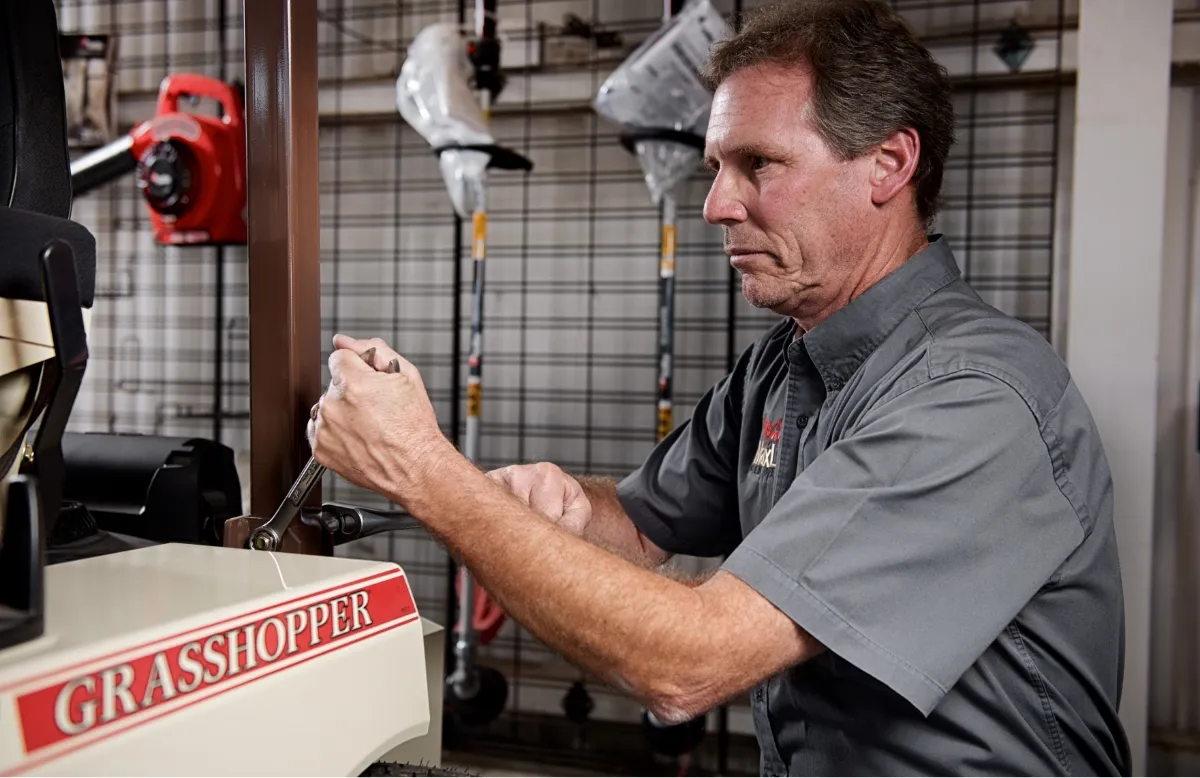
As mentioned, standardizing mowers makes it easier to maintain adequate inventory levels of common maintenance and wear items. Additionally, mechanics can become more proficient at servicing mowers because they’re encountering the same design, systems and components from one mower to the next, as opposed to having to learn the nuances of several different brands.
4. Simplified operator training
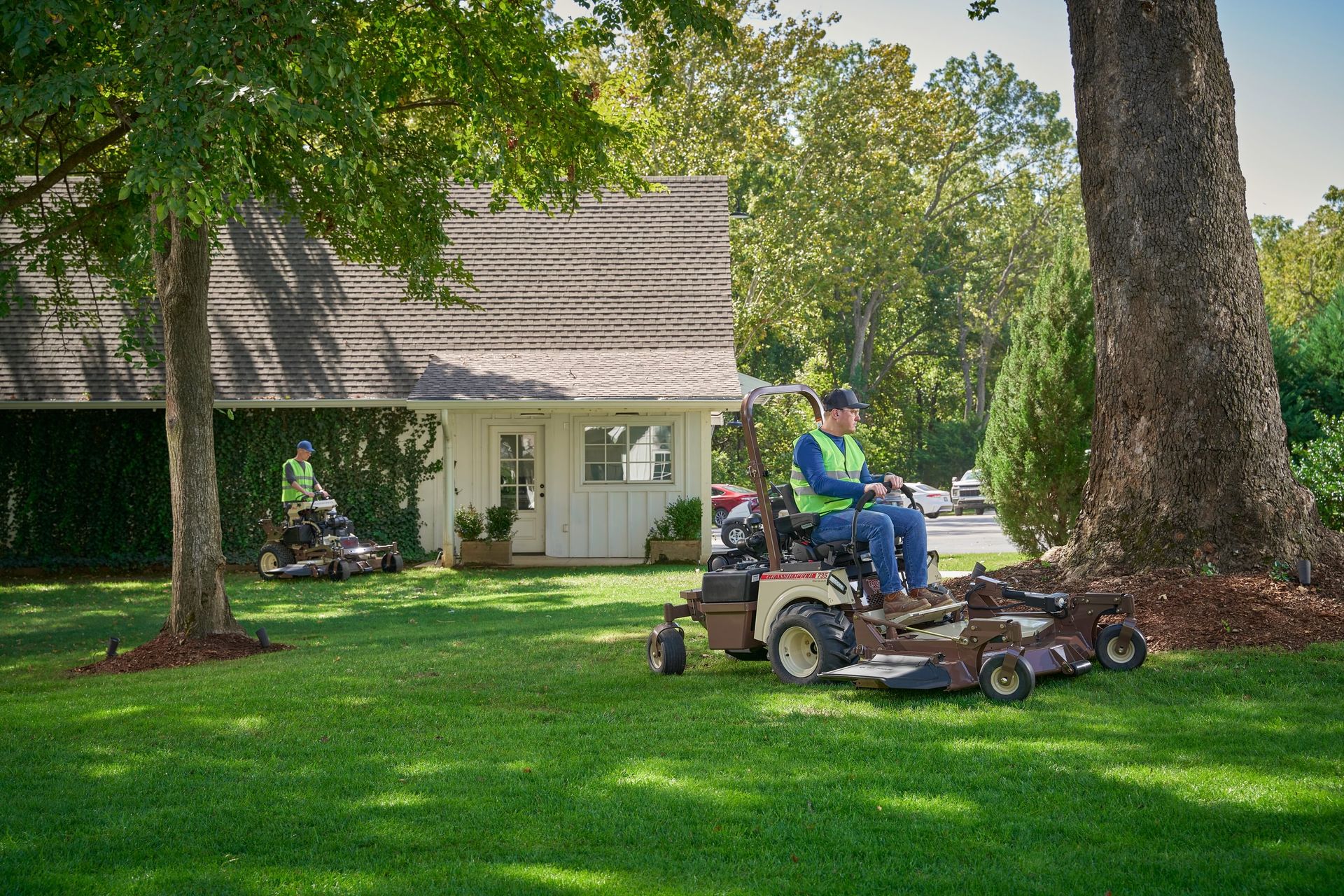
It’s easier to train employees when everyone is operating the same type of commercial zero-turn mower with the same controls, safety features, and overall feel. Furthermore, it’s more practical to shift employees from one crew to another if they don’t have to worry about operating an unfamiliar mower.
5. Stronger buying power
Rather than spreading your investment across several suppliers, standardizing a mower fleet helps consolidate your spending to a single manufacturer and dealer. That bolsters your buying power. Grasshopper, for example, offers fleet pricing for commercial users who own multiple zero-turn lawn mowers—even when purchasing just a single unit to incorporate into an existing fleet.
6. Stronger resale/trade-in value
A well-maintained piece of equipment is typically worth more in the used market. Standardizing a mower fleet makes it easier to keep up with preventive maintenance and maintain good records, helping fleets maximize resale value. This is especially true when the mower already has a reputation for durability and long life, as is the case with a Grasshopper.
How to standardize your mower fleet
Standardizing a mower fleet requires you to determine the type of mower that will be best for your crews, identifying the manufacturers that produce that type of mower, and evaluating each manufacturer based on factors related to cut quality and overall mower performance, operator productivity, and total cost of ownership.
The first step is determining which type of mower will be best for your crews and the types of properties they service. For example, large industrial complexes may be best served by a larger mid-mount, whereas retail complexes with variably sized lawn areas may be best served by a smaller stand-on mower.
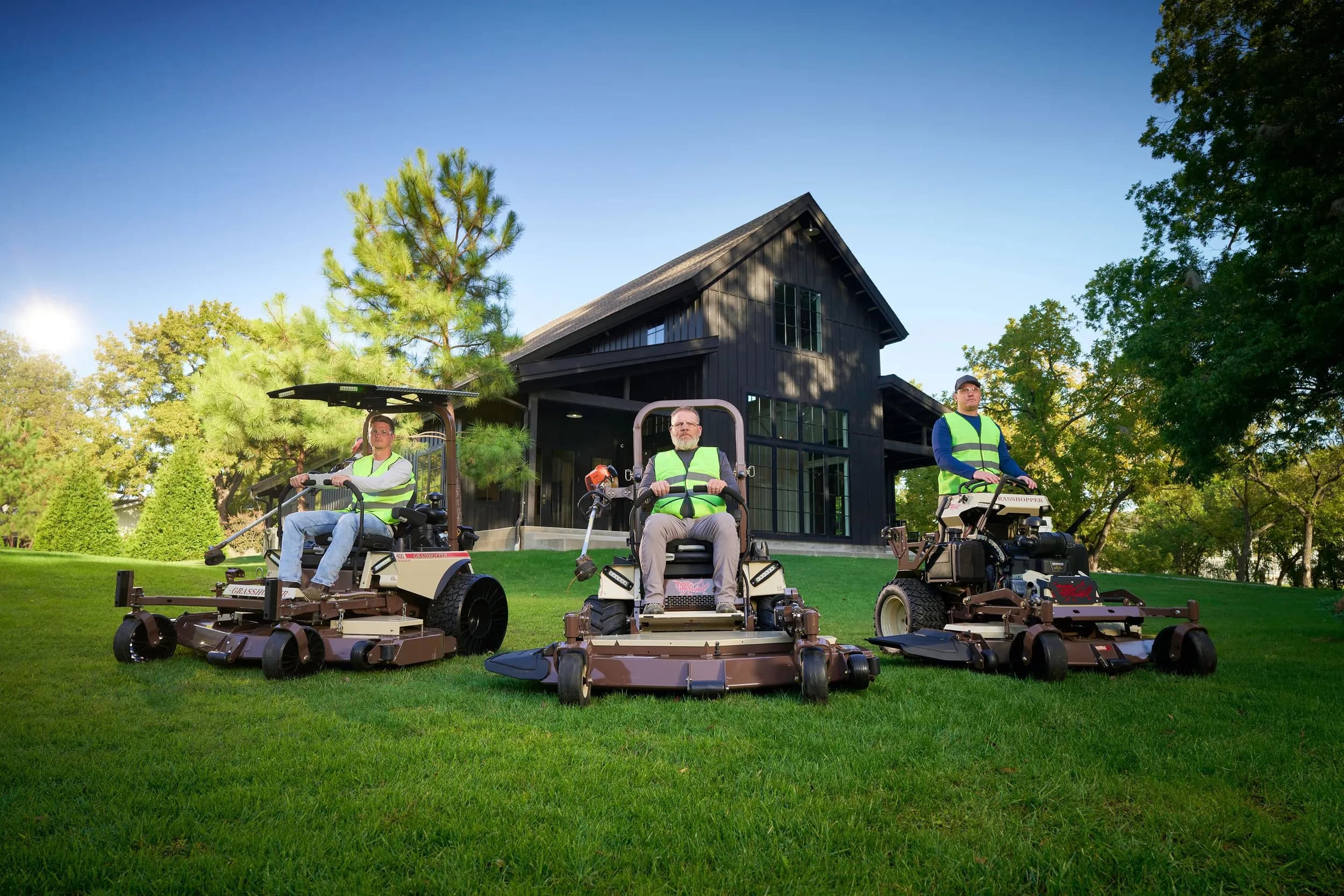
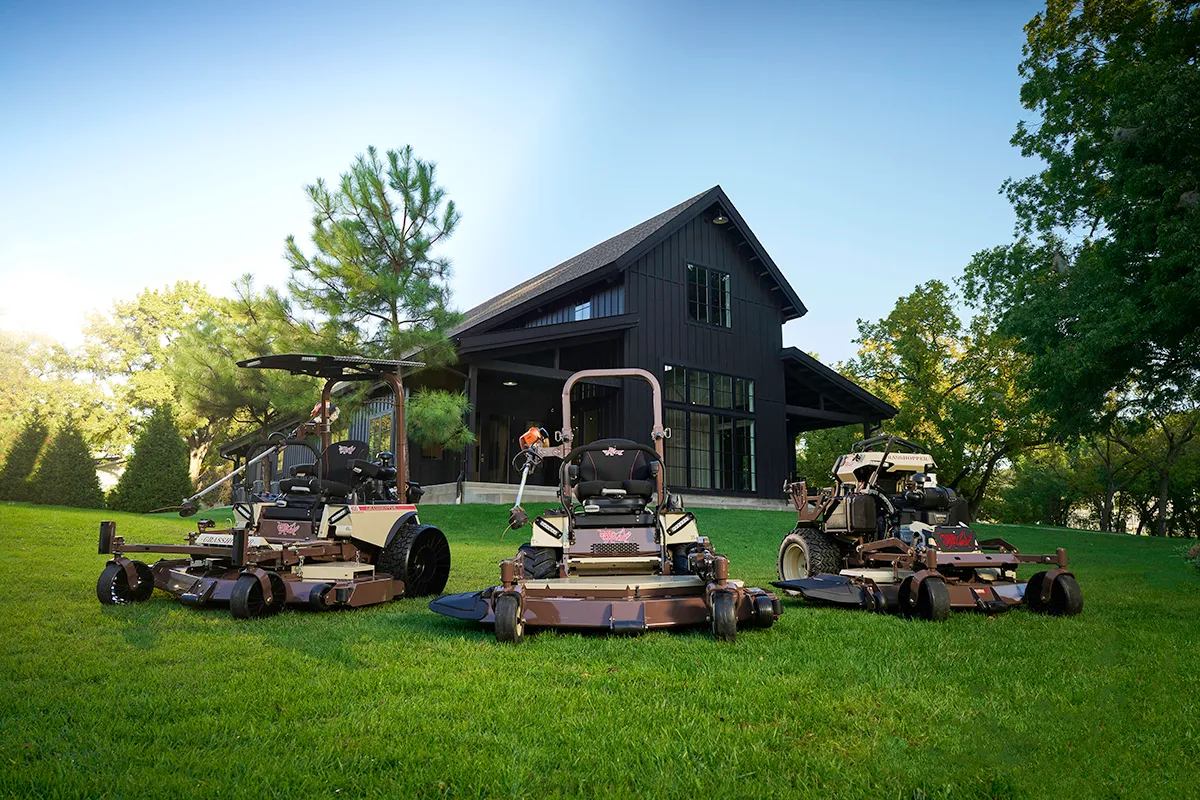
Even when you determine that your fleet will require more than one type of mower, it may still be possible to standardize a single brand. For example, Grasshopper offers MidMount™, FrontMount™ and OutStander® Stand-On zero-turn lawn mowers with options to side discharge, rear discharge, mulch and bag.
Whatever your situation, you can identify the manufacturers that offer the mowing solutions your operation requires, and evaluate those solutions based on the following criteria:
- Cut quality
- Operator comfort
- Durability
- Ease of maintenance
- Versatility (e.g., mulch or bag, operate attachments)
- Buying incentives
- Dealer support
- Total cost of ownership
Once you’re comfortable with your mower selection, you can begin the process of standardizing your mower fleet. Keep in mind that it may take a few years to complete the conversion, since you may be in the habit of replacing just a portion of your fleet at a time. That’s OK. In fact, a phased-in approach can be a good way to preserve cash flow and profitability, while allowing more time for employees to become better acquainted with operating and servicing the machines. A phased-in approach will also allow more time to convert your parts inventory.
Wondering if Grasshopper could be the solution you’re looking for to standardize your lawn care fleet? Check out our Online Mower Model Chooser to see what’s a good fit.
Ready to talk to a dealer?
Frequently asked questions
Yes—standardizing a landscape company's mower fleet to a single brand saves money in six distinct ways. Those are streamlined parts inventory, predictable maintenance scheduling, faster equipment service, simplified operator training, stronger buying power, and stronger resale value. Consolidating spend to one manufacturer also unlocks fleet pricing and shrinks the parts you must stock.
When choosing a commercial zero-turn mower to standardize on, evaluate each option on cut quality, operator comfort, durability, ease of maintenance, versatility, buying incentives, dealer support, and total cost of ownership. Begin by analyzing the properties your crews maintain, then match those needs to a manufacturer that offers the right mower types and deck sizes.
Yes—you can standardize to one brand even when different properties need different mower types, as long as that manufacturer offers the range you require. Grasshopper Mower, for example, makes MidMount™, FrontMount™, and OutStander® Stand-On zero-turn lawn mowers, so a spacious industrial complex and a feature-heavy retail property can both run the same brand.
To standardize your mower fleet, first analyze the properties your crews maintain so you know which mower types and deck sizes the work actually demands. Then identify a manufacturer whose lineup covers those needs, weigh your options, and begin converting the fleet—commonly in phases, replacing part of the fleet at a time rather than all at once.
Standardizing a mower fleet can take a few years, because landscape companies often replace only part of the fleet at a time rather than all at once. A phased approach is fine—it lets you test one brand for a year or two before committing fully. With the right manufacturer, the savings can still be felt almost immediately.
.webp&w=3840&q=75)